The Troublemaker and His Rebel City
Published in the New Annales of The Roosevelt Group (2025)
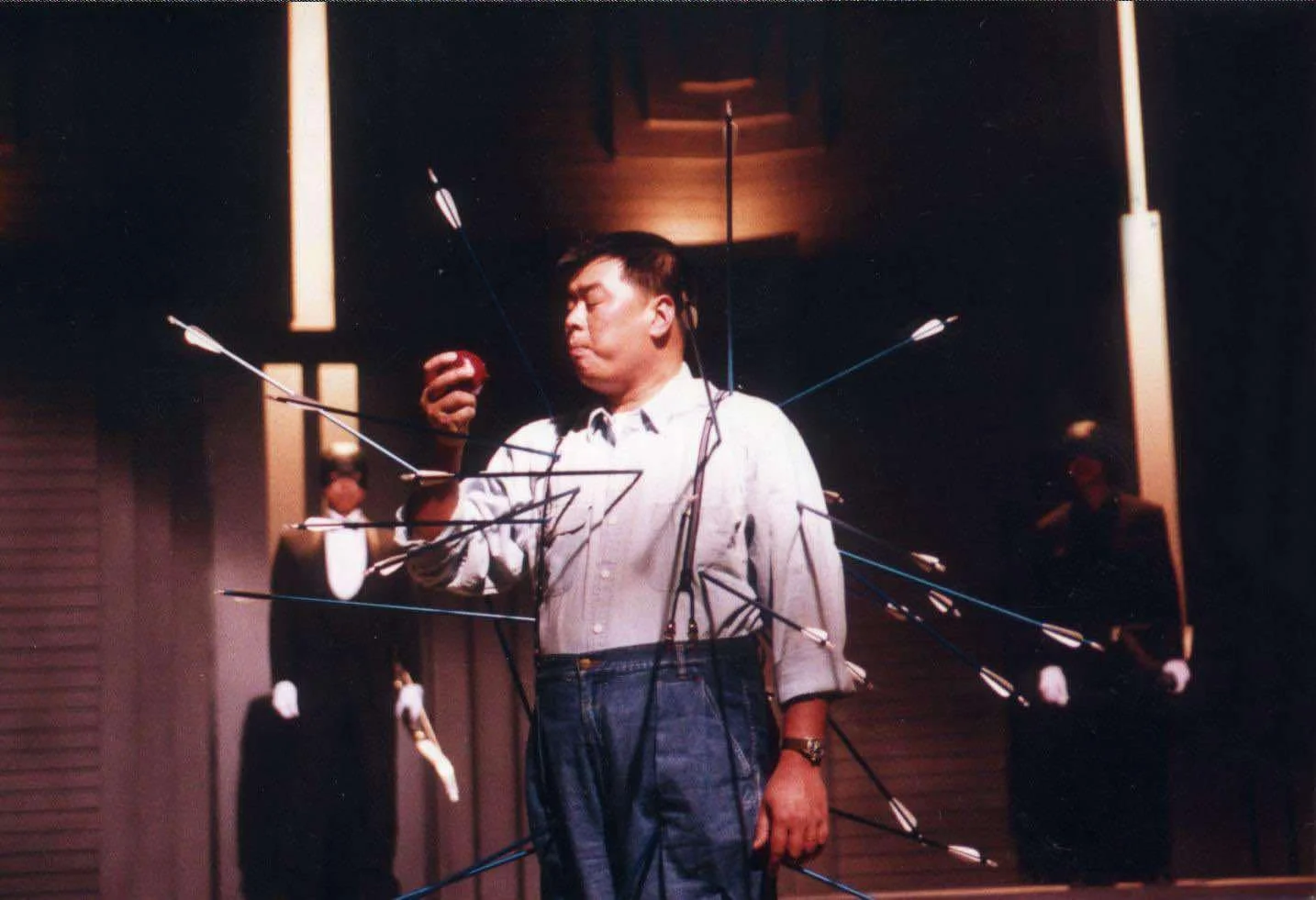
There are men who bow to power, who measure their words carefully, who know when to leave a fight. Jimmy Lai was never one of them. When history came knocking, he chose to stand.
Controversial, revolutionary, and emblematic of Hong Kong’s rebellious legacy, Jimmy Lai has become a defining figure in the city’s modern history. His decision to remain in Hong Kong, despite the threat of arrest under the National Security Law (NSL), stands as a testament to his principles.
For Lai, life has always been a series of defining choices. As his son, Sebastien, told me, his father’s story unfolds in three acts: refugee, entrepreneur, and prisoner of conscience. He arrived in Hong Kong at twelve, smuggled out of China with nothing. He worked, he hustled, and he built something remarkable—first in retail with Giordano, then in media with Next Magazine and Apple Daily. But where most men would have stopped, satisfied with fortune, Lai pressed on. Because in 1989, something shifted.
Blood on the Pavement, Fire in the Gut
1989 marked a turning point for Hong Kong. For decades, the city had moved at breakneck speed, its people consumed by the pursuit of prosperity. Money meant freedom—economic success was the great equaliser, the hedge against colonial rule, a path to self-determination, an insulation from the uncertainties of the future.
Then came Tiananmen. Pro-democracy protests erupted on the mainland, capturing imaginations across the border. There was admiration at first—then shock, then grief, as Deng Xiaoping’s tanks rolled in. The military crushed the peaceful demonstrations. The brutal suppression sent shockwaves through Hong Kong, especially with the 1997 handover to China looming on the horizon.
Xiaoping made his decision, and the world watched. The images were grainy, but the message was clear: there would be no democracy, no compromise, no path forward that diverged from the Party’s will.
For Lai, Tiananmen was a reckoning, it was personal. “When I first noticed what happened in Tiananmen, I was very moved,” Lai recalled in an interview. For most of his years in Hong Kong, Lai had kept his distance, “I was always trying to run away from China since the time I escaped,” he said. “Anything China represented; I wanted to forget” (Sirico, 2020).
But the students, the gunfire, the senseless violence, “suddenly, it was like my mother was calling me in the darkness of the night, and my heart opened up.” (Sirico, 2020)
Many believed that China’s economic reforms, coupled with the Tiananmen protests, would open the door to political change. Instead, the government doubled down. The crackdown in Beijing was ruthless and unapologetic. In Hong Kong, anxiety over the future deepened. For Lai, Tiananmen was a turning point. From that moment on, he would publicly and defiantly oppose the Chinese Communist Party.
Freedom Isn’t Free, But It Sells
On March 15, 1990, Lai launched Next Magazine, a weekly that did what few in Hong Kong dared. It was brash, relentless, unafraid—offering a cocktail of free-market ideas, political defiance, and scandal.
But fear was thick in the air. Hong Kong’s elite whispered warnings—don’t provoke Beijing, don’t forget who will soon be in charge. Lai ignored them.
“I asked myself, if I just keep making money, what does it mean? But if I go into media, if I deliver information—choice is freedom. I will be making money and bringing freedom. That is wonderful.” (Clifford 2024, 70)
Next magazine was part tabloid spectacle, part serious journalism, wholly disruptive. Paparazzi hounded starlets, but alongside them were free-market economists, political exposés, hard-hitting investigative pieces.
Lai poured $6 million of his own money into the venture. He hired the best writers, the boldest cartoonists, the sharpest editors.
“Don’t think about costs,” he told his team. “Think about the product. Keep trying, keep experimenting. The money will come.”
“When you can’t make mistakes, it’s perfect because you are dead” (Clifford 2024, 74)
Next did what no other publication had done: it put Hong Kong’s rich, powerful, and corrupt under a magnifying glass. The covers were aggressive, the headlines uncompromising, the editorials biting. With deep pockets and an independent streak, Lai funded the kind of investigative journalism where his reporters dug deep, exposing the triads, the tycoons, the government. They published photos of gangsters’ birthday parties, exposed prostitution rings, and printed the stories that made powerful men sweat. Beijing was watching.
The Middle Finger is a Turtle Egg
For all of Lai’s bravado, his writing was direct, often crude, but always his own. It was a single column in 1994 that sealed his fate with China. That summer, Premier Li Peng, known as the “Butcher of Beijing” for his role in Tiananmen, toured Europe. Lai wrote a column that was impossible to ignore.
He called Li a “national humiliation.” He slammed the Communist Party’s corruption and cruelty, saying it treated people as disposable tools, rather than individuals. And then, in a flourish that would echo across Hong Kong, Lai addressed Li Peng directly:
“I want to tell you that not only are you a bastard, you are a bastard with zero IQ.” (Lai 1994)
In Chinese slang, gui dan—”turtle egg”—is an extremely derogatory term. It implies a man is cowardly, so disgraceful, that he does not even know who his parents are.
His editor barely gave it a second thought. ‘Who cares? We’re in Hong Kong. We have free speech.’ (Clifford 2024, 77)
But Beijing cared.
No Seatbelt, No Exit, No Regrets
The backlash came fast. Chinese authorities targeted Lai’s Giordano stores on the mainland. The move was classic Communist pressure—hit a man in his wallet, and he will fall in line.
Other businessmen would have backed down. Lai doubled down.
Instead of silencing or softening Next, he walked away from Giordano altogether, selling his stake for $185 million. Media over money, defiance over safety. With Hong Kong’s 1997 handover looming, Lai prepared for his next act—one bigger, louder, and even more unrelenting.
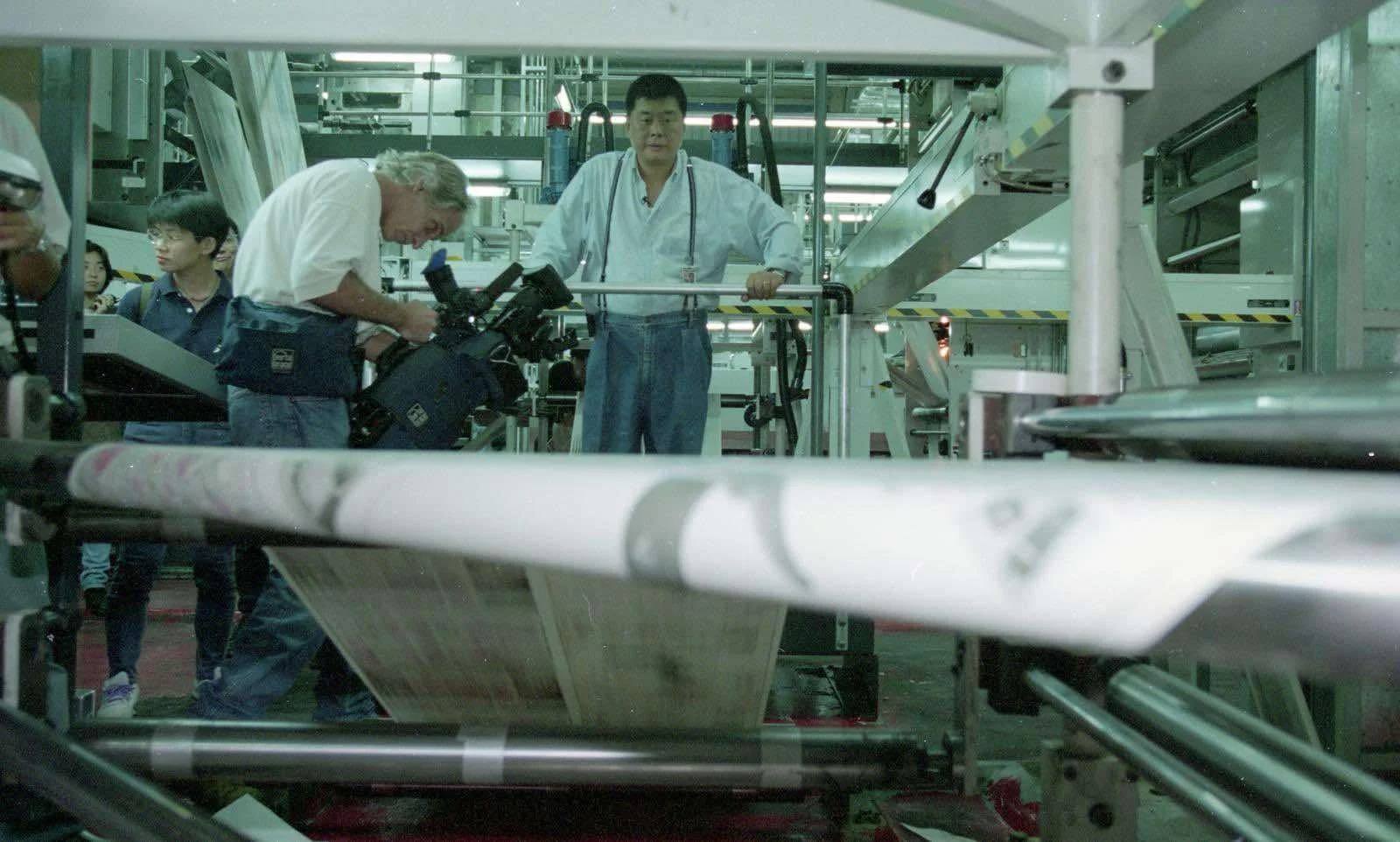
Apple Daily, a daily newspaper, gave Lai and his team the power to confront corruption, push for democracy, and hold the powerful to account—every single day. If Next Magazine was a warning shot, Apple Daily was a declaration of war.
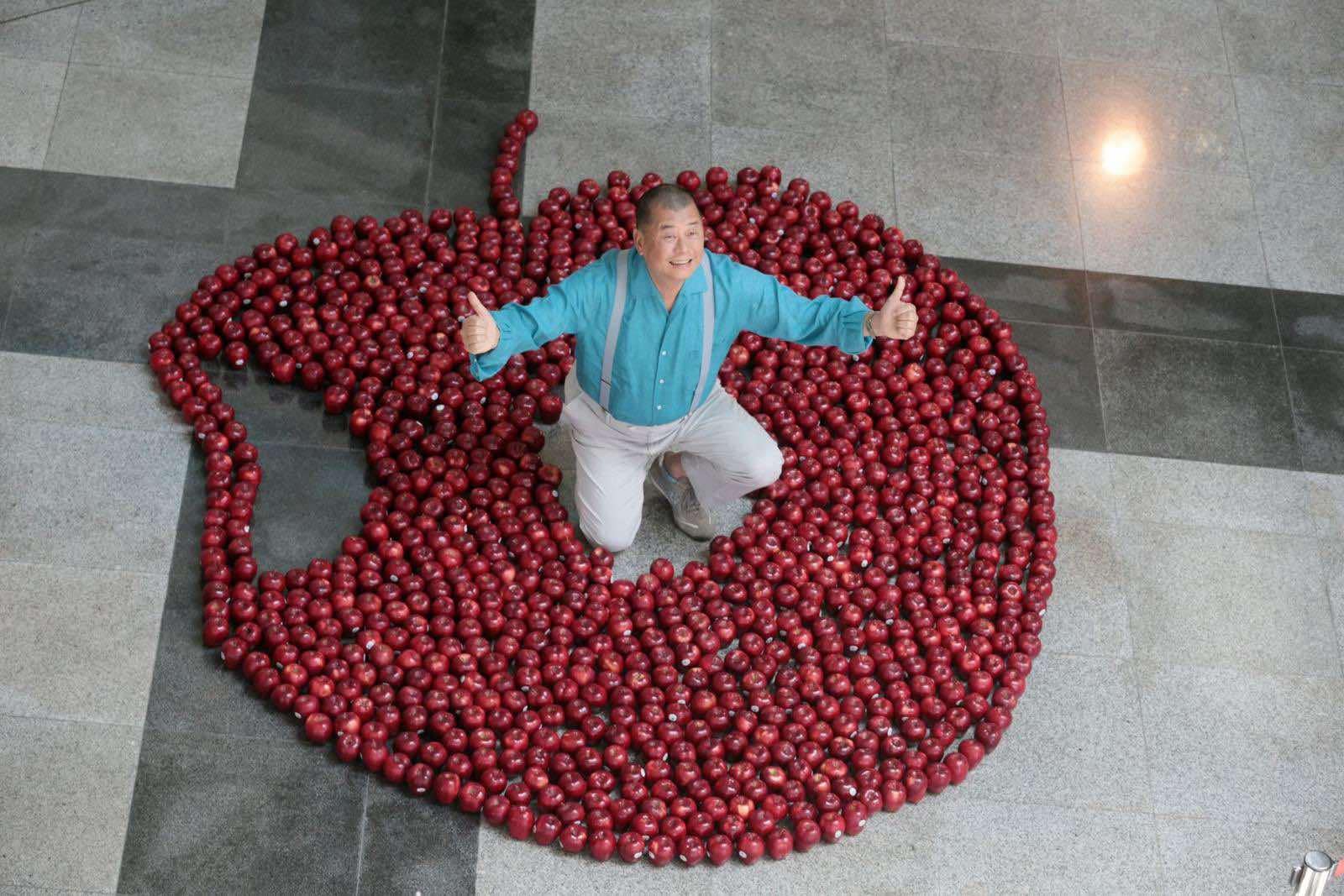
“Growing up, a lot of people made fun of him because he was trying to break into media,” his son Sebastien Lai recalled. “He only had a fifth-grade education. Even though he had been successful with Giordano, people would tell him, You’re uneducated. Go back to your factories.” Then, when he became the biggest newspaper in town, they stopped laughing.”
Some called him fearless. Others called him reckless. Beijing called him dangerous. Regardless, Lai had crossed a line, he had chosen his fight.
“I will fight for freedom, I will not give up anticommunism, I will never give up my dignity as a human being, never will.” (Lai 1994)
A Daily Disruption
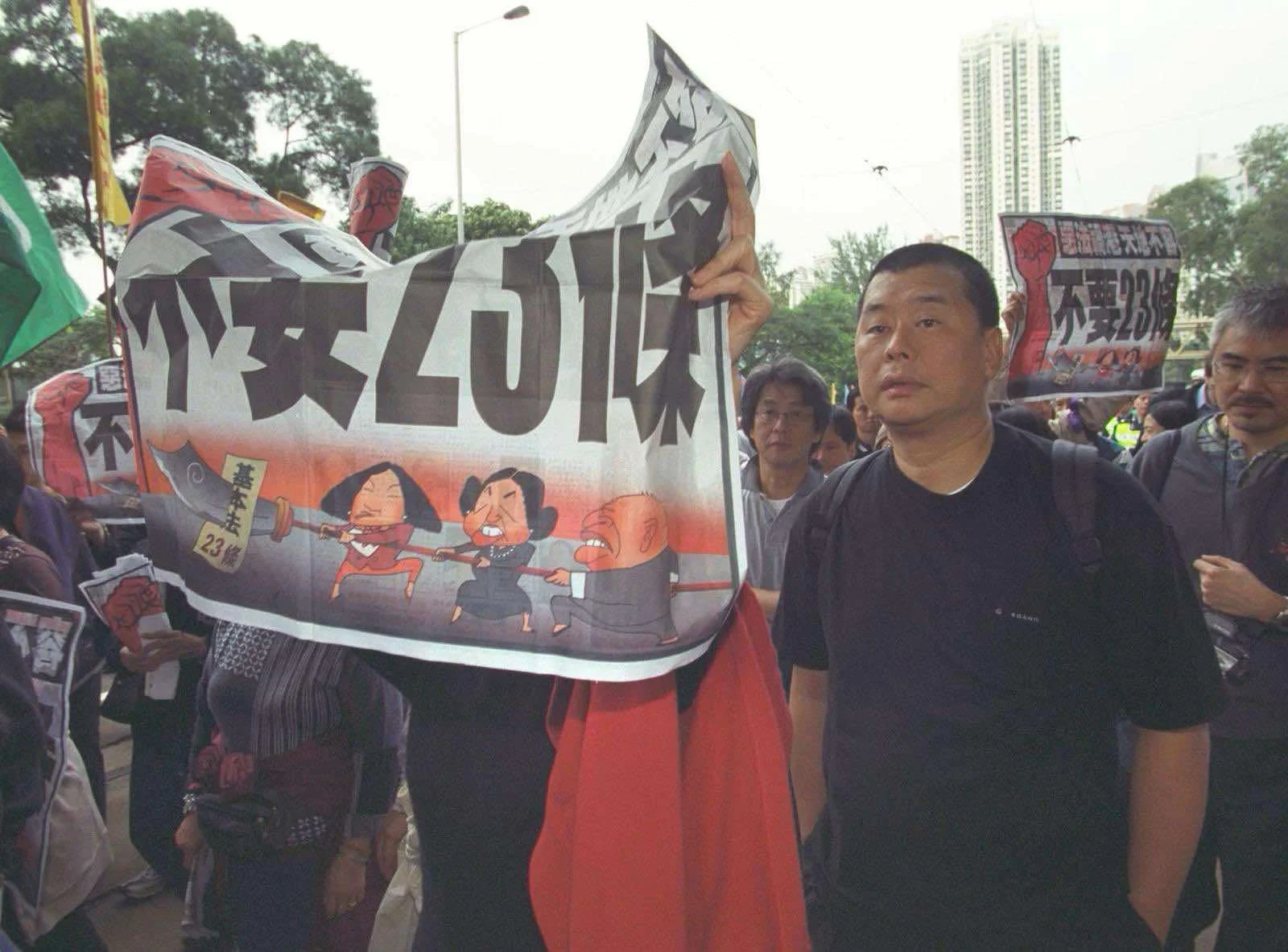
Lai was not just a man of words but a man of action. When Beijing introduced national security legislation in 2003, the week before a planned protest, Next ran a cover showing the city’s Chief Executive getting hit in the face with a pie. Apple Daily turned its front page into a protest sign. Half a million Hong Kongers took to the streets. The government backed down.
For the CCP, this was intolerable. Dissent, left unchecked, is contagious. The CCP rules through fear, and Lai was proving that fear could be broken. He had money—so he could not be bought. He was faithful to his wife—so he could not be blackmailed. And he had built a media empire that refused to be silenced. He was a problem.
Ink, Fire, and Tear Gas: 2014
The protests began with an image—an anonymous figure in a storm of tear gas, gripping an umbrella like shields against the inevitable. A futile gesture, but a powerful one. That image birthed a movement. The Umbrella Movement was not just an act of defiance; it was a desperate bid to halt the slow erosion of Hong Kong’s fragile autonomy.
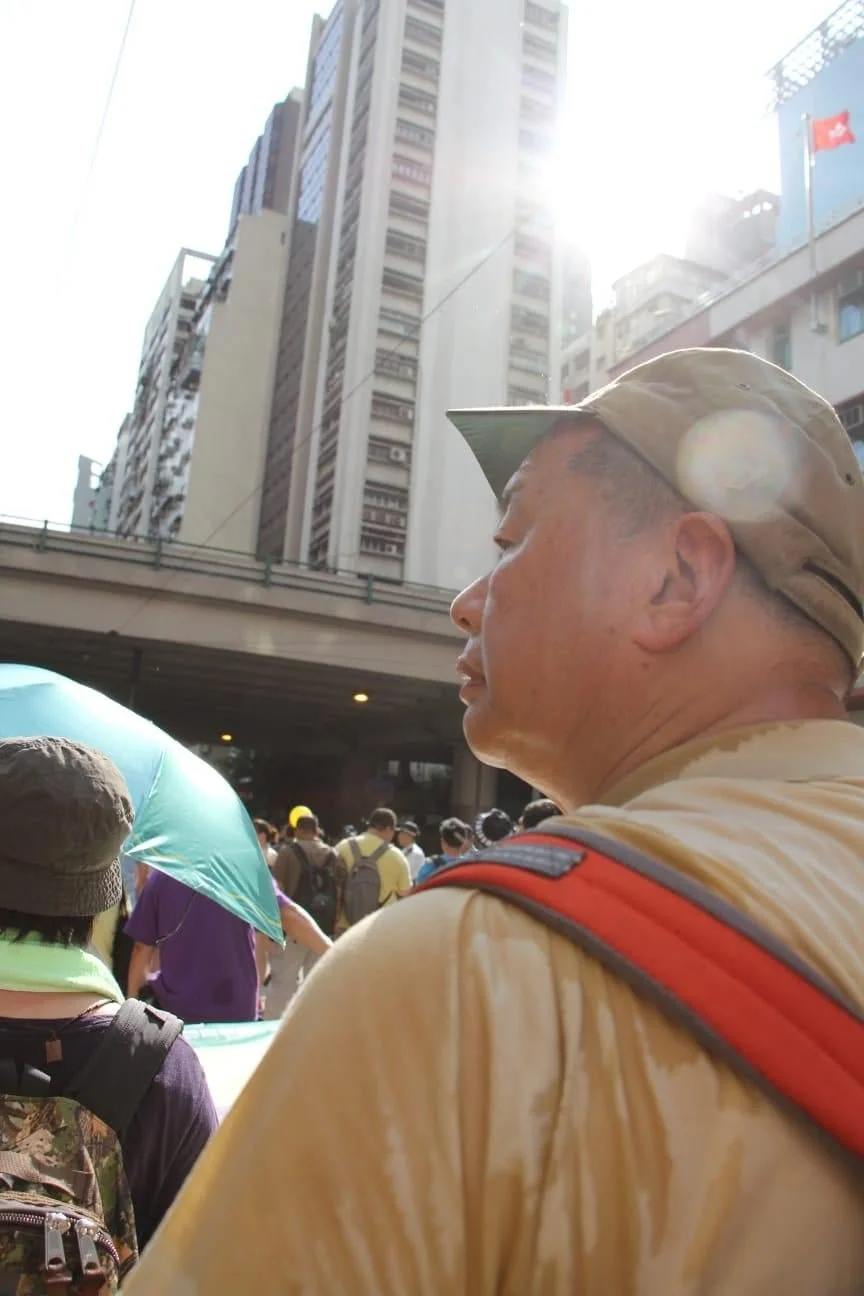
Lai, who had spent decades wielding ink as a weapon, now took to the streets. He was there, at the front of the crowd outside government headquarters, amid thousands demanding democracy. On a sweltering night, the police fired 87 rounds of tear gas—the first time in half a century the government had turned such force against its own people. Somewhere in the background of a Time magazine cover, half-obscured by smoke, was Lai—mid-cough, eyes burning, unbowed.
The occupation spread across Hong Kong, morphing into a network of makeshift encampments. Apple Daily threw its weight behind the movement, framing it not just as a student uprising but as a battle for Hong Kong’s very soul.
Its pages bled yellow—umbrellas, banners, resistance. The newsroom, once dismissed as tabloid sensationalism, had become an institution of defiance.
Dennis Kwok, a barrister and former sceptic, was among those who changed their minds. “Apple Daily was always a trashy paper,” he admitted. “But when the others fell in line, when they let Beijing pull their strings, it was Apple Daily that remained. The only paper left standing.” (Clifford 2024, 155)
It came at a cost. Beijing’s anger turned to retaliation. His home was firebombed. A car rammed his gates. They sent his sister to his doorstep, using her as a pawn to pressure him into submission. He ignored it all. When his aides suggested security, he scoffed.
“I don’t want them to think I’m afraid,” he said, “I am fine. I am not scared.” (Clifford 2024, 159)
Then came the pig organs.
November 12, 2014. Lai sat outside his tent when three men approached. Without a word, they dumped a bucket of foul-smelling slop over his head. Another wave followed—rotting pig intestines, bile, blood.
A message, soaked in humiliation.
His son Sebastien asked if he was alright. Lai shrugged. “He was pretty light-hearted about it,” Sebastien recalled (Clifford 2024, 159). But there was no mistaking the escalation. This was different. This was personal. If anything, it hardened his resolve. He had spent decades funding the cause of democracy. Now, no longer just the man writing the headlines—he was the headline. He had put his body on the line, and Beijing had noticed.
Beijing’s grip tightened. It all built to the inevitable climax of the 2019-2020 protests and the National Security Law in 2020. Hong Kong’s identity, once a delicate balance of contradictions, was being ground down, reshaped under China’s weight. Before the 2008 Beijing Olympics, Hong Kong still felt tethered to China, a shared history not yet severed. But then came the squeeze, a slow suffocation. What had been a reluctant embrace turned into a quiet rebellion. Hong Kongers began to understand their identity as distinct, and not as an extension of the mainland.
Bending the Knee: 2019-2020
It began with an extradition bill. In 2019, Hong Kong erupted. Millions flooded the streets, first in peaceful protest, then in raw defiance against a government that no longer represented them. The city’s youth, armed with umbrellas and helmets, faced down riot police who answered with tear gas, batons, and bullets. Fires burned, bodies bled, and the once-orderly subway stations turned into war zones.
Beijing watched and waited. When the movement refused to die, it crushed it. The National Security Law, passed in 2020, was a death sentence for Hong Kong’s freedoms. Arrests came swiftly—activists, journalists, politicians, and ordinary citizens as young as 15—all swept up in a law so broad it criminalized defiance itself. The city that had prided itself on being different from the mainland was now just another piece of China’s machinery, its voice silenced under the weight of repression.
The Day the Free Press Fell
Jimmy knew they would come for him. On August 10, 2020, they came—200 police officers storming Apple Daily, rifling through files, seizing computers, dragging reporters from their desks. Lai, then 72 years old, was led away in handcuffs, accused of ‘colluding with foreign forces’—a crime with no clear definition, designed only to punish.
His newsroom, once a sanctuary for free press, was now occupied territory. His arrest was not about justice; it was about erasing the idea that Hong Kong had ever been free. But if the police had hoped to break him, they miscalculated. Even in cuffs, Lai walked with his head high. He knew what was coming.
In the months that followed, the screws tightened. Apple Daily was forced to shut down. Its final edition—one million copies printed in defiance—vanished from the shelves by morning.
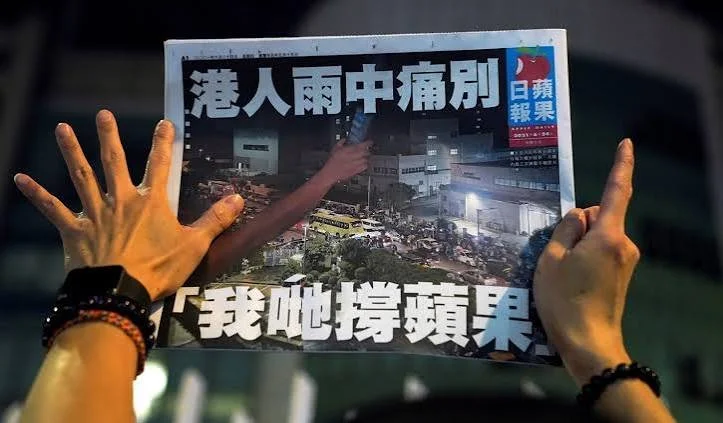
Currently at 77 years old, Lai has been imprisoned since December 31, 2020. He faces charges of colluding with foreign forces and publishing seditious material under the NSL.
Lai has pleaded not guilty. Human rights groups call him a prisoner of conscience; Beijing calls him a threat. The world watches, knowing that his fate is not just his own—it is a measure of Hong Kong’s vanishing freedoms.
Lai’s presence, his defiance, was a reminder of a different Hong Kong.
“Like a good captain of a ship,” Sebastien said, “he decided to stay.” It was not a calculated or grand strategic choice—it was personal, human. He believed that by remaining, he might shield his journalists, his colleagues from greater government scrutiny.
The Hollowing Out of Hong Kong
Hong Kong was never supposed to be like this. It was the city that defied expectations—a place of contradictions, where free speech thrived under a one-party state’s looming shadow. But that Hong Kong is fading.
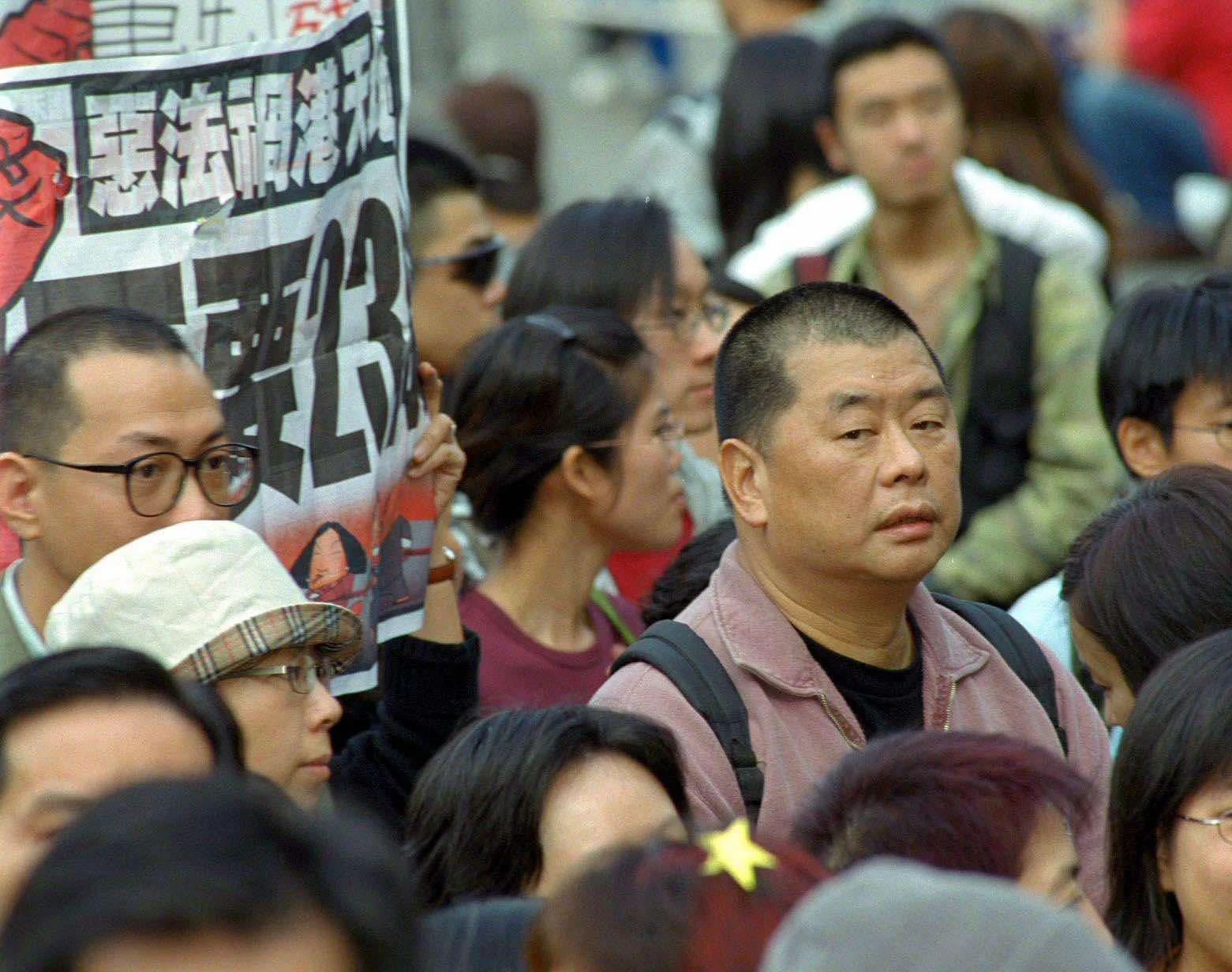
“Hong Kong was always a city of refugees,” Sebastien told me. “Most people there can only trace back one or two generations. We’ve always been resilient. But now?” He hesitated. “The road Hong Kong is going down is a dark one.”
This isn’t just about a law. It’s about identity. “They are snatching away an integral part of Hong Kong,” he said. “This was a city that had more freedoms than anywhere else in China. We took pride in that.” The world watches as businesses pack up, as the stock market dwindles, as a city that once pulsed with energy dims. “There are still 1,800 political prisoners,” Sebastien reminded me. “My dad is still in jail. And all we ever wanted was what people in the free world take for granted—representation, basic freedoms.”
What happens when a city that roared falls silent? What remains when its people stop fighting? These are questions Hong Kong has never had to ask—until now.
A Father’s Sacrifice, A Son’s Fight
For Sebastien, this is more than a political struggle. It is a personal one. “I’ve been advocating for his release for two years now. It’s overwhelming. It’s lonely. And yet my father did it for 30 years—not just for us, but for Hong Kong.” He wonders if there’s still hope. “To be honest, I don’t know. I haven’t been back in four years. It’s still my home, obviously. But without freedom, without the rule of law—why would smart, competent people stay?”
Hong Kongers are redefining what it means to be one of their own. “People used to think we only cared about making money. Then 2019 happened. The protests showed we wanted more. And now, they’re trying to erase that.”
Lai fought back with ink and paper. Now, those tools are gone. “They used to say you could criticize the government in Hong Kong,” Sebastien said. “Now, that’s completely illegal. It used to be that the law protected you. Now, the law is the weapon used against you.”
His father’s fate is still unfolding, but one truth is clear: Lai made his choice. He had wealth, power, and an easy escape. Instead, he chose to stand his ground. And for that, he is paying the highest price.
On February 4th, the prosecution pressed Lai, looking for a crack, a concession. Instead, they got a challenge.
“What’s wrong with fighting for conscience?” he shot back. “This is everybody’s conscience. This is Hong Kong’s conscience.”
No apologies. No hesitation. Just a man who had bet everything on a city that once believed in him.
In the end, it is not only Jimmy Lai who stands trial.
It is Hong Kong itself.